
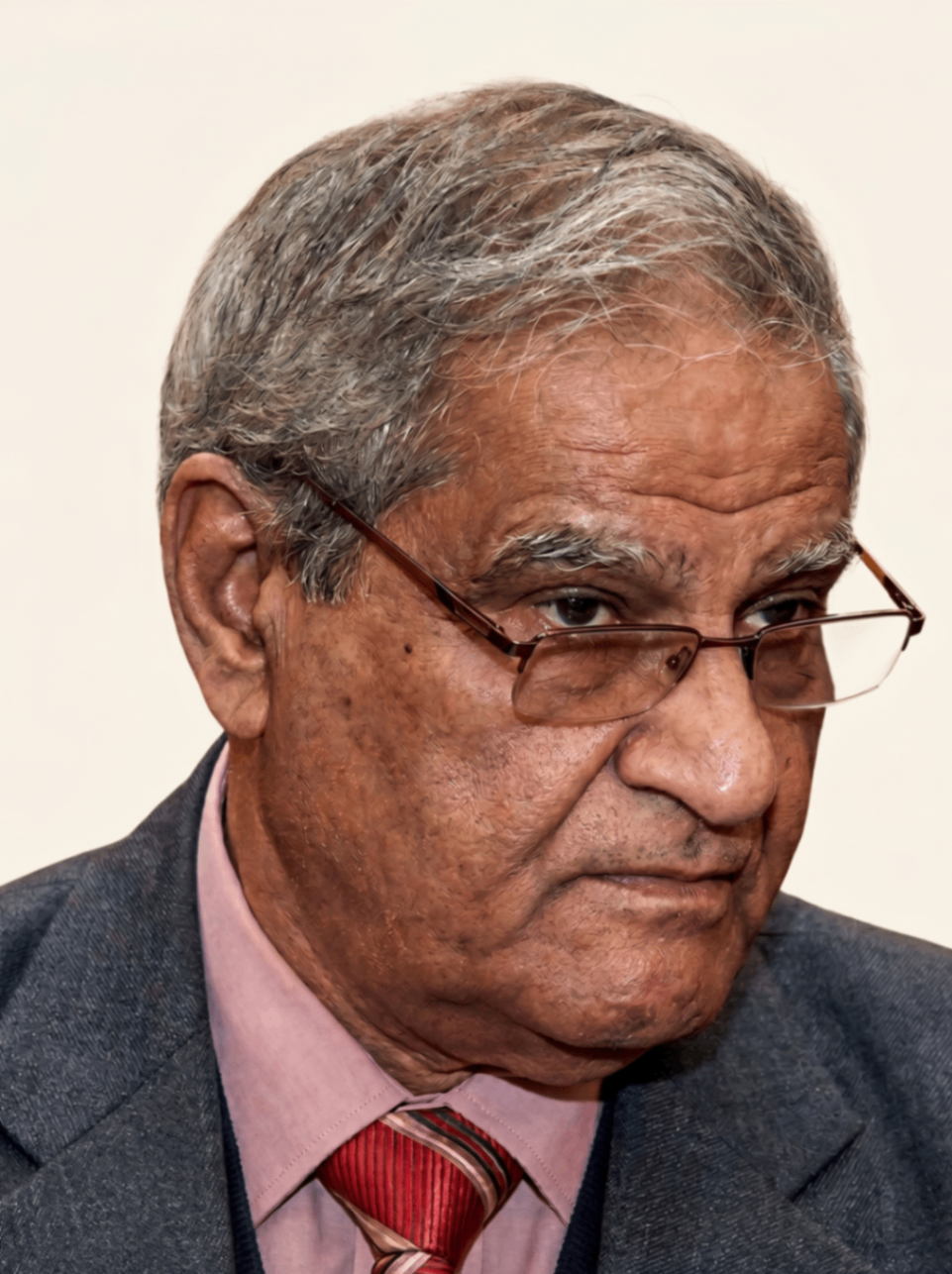
Author
The Fifth Wave reflects years of deep thinking and personal experience reshaping how we understand the world
Advisor
Senior advisor to heads of investor institutions, universities, and public government institutions
Speaker
Keynote speaker at Helwan University, and many public institutions
Scholar
At several institutions within the Arab Republic of Egypt
"The world does not need more analysts. It needs thinkers who can see the architecture beneath the noise."
Prof. Magdy Ibrahim belongs to a generation of thinkers concerned with analyzing major civilizational transformations and linking them to the structures of development, urbanism, and governance — from a perspective that transcends traditional national frameworks toward a comprehensive planetary horizon.
He obtained his PhD in the philosophy of industrial design from Helwan University in 1980 and pursued an academic career culminating in his position as Professor of Industrial Design at the Faculty of Applied Arts, Helwan University in Cairo. The interaction between philosophy, design, and development has constituted the cornerstone of his intellectual project. He approaches design not merely as a formal activity, but as a civilizational tool for restructuring the relationship between human beings, resources, cities, and the state.
His experience extends beyond academia into institutional and investment practice, where he held leadership positions in the fields of industrial development and investment. He has directly observed and participated in the dynamics of interaction between the state, institutions, and investors within the framework of modern development systems.
This dual experience — both theoretical and applied — has enabled him to identify the gap between prevailing development models and real-world needs, particularly in a world undergoing rapid transformations across political, economic, and technological dimensions.
The intellectual project presented in this book is grounded in a central premise: that the world has entered a new phase of civilizational transformation in which national tools and traditional development models are no longer sufficient to manage increasing global complexity. Accordingly, the concept of Planetarism is introduced as both a theoretical and practical framework aimed at restructuring development, governance, urban systems, and institutions on the basis of conscious and organized planetary interconnectedness.
"We are not witnessing the end of order. We are witnessing its reinvention."
Read The Fifth Wave
The most comprehensive work yet on the forces reshaping the global order. Order your copy today.